Tanya Ursova January 2000
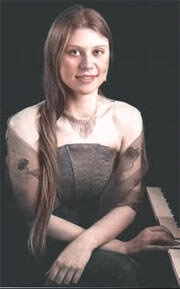
It might seem an odd thing for a Guitar Society to put on a piano
recital, but that is precisely what the Greenwood Guitar Society did
on Thursday, January 27th 2000. The cause was certainly a good one:
to showcase the young Ukrainian Tetyana ("Tanya") Ursova, ahead of
her starting a Postgraduate Performance course at the Royal Academy
of Music in September. Miss Ursova graduated from the Donetsk State
Music College in the Ukraine in 1996, and will do so from the State
Conservatoire there this coming May. In the meantime, she has been
accumulating much experience (and a range of minor prizes, diplomas,
and a bursary with Norma Fisher for the 1999 Summer Master Course in
London) in various international competitions, as well as on the
stage at her. One notable event she participated in at home was a
lecture recital on English music.
The programme she played for Greenwood was wide-ranging and designed
to display her accomplished technique, tending primarily to the more
popular end of the spectrum. These included Beethoven's
chocolate-box bagatelle "Fur Elise" (taken refreshingly swiftly -
closer to the composer's original tempo than normal), Chopin's
evergreen A major Polonaise and 18th. Etude (Op. 26 no. 6), Liszt's
"Liebestraume" and Debussy's "Clair de lune" and "Golliwog's
Cake-walk". Chopin and Liszt clearly suit Miss Ursova's temperament
to a tee, and drew from her the warmest playing of all. The recital
opened, however, with the largest item and a work requiring
considerable intellectual steel to tackle successfully: Ferruccio
Busoni's mercurial transcription of the sublime Bach Chaconne. It
was a bold opening gambit, but it came off well. Miss Ursova's
account was well-paced, with a good grasp of the overall structure.
Some of the grander gestures were lost on the inadequate instrument
(of which more below) but her performance nonetheless communicated
the work's wide range of moods, its power and quietude very ably.
Four Russian pieces provided various degress of novelty:
Rakhmaninov's Polka (de W.R.) is not well known at all, though there
are a dozen or so (mainly historical) recordings available. It was
apparently written in 1911 as something of a joke, and its burlesque
nature illuminates a side of the Russian not often seen in his more
famous compositions. Prokofiev's nine piano sonatas are not as well
known as they should be, although the wartime trilogy of Nos 6-8
have received much attention in the recording studio. Miss Ursova's
account of the very subtle Waltz movement from the Sixth was rather
fine, bringing an element of gravity, melancholy-in-disguise even,
to the programme. This contrasted nicely with the F major Prelude
and Fugue "in the jazz style" of the leading Ukrainian composer
Myroslav Skoryk (b. 1938). This is one of a dozen preludes and
fugues drawing inspiration in musics from around the world (that in
B flat, seemingly, draws on Chinese elements). Blues and jazz are
the medium for the F major, a fine, fun piece with a nicely off-beat
ending, and well played. The recital closed with the Toccata on
Ukrainian folk themes by another of Miss Ursova's compatriots,
Fillipenko. This veritable whirlwind of notes was cleanly executed
and made for an exciting conclusion.
The only negative aspect to the recital, and alas a significant one,
was the state of the hall's piano. A guitarist when encountering
problems or variances of intonation can at least retune his
instrument, or adjust his fingering to compensate. Not so the
pianist, in most cases dependent on the instrument in situ. Badly
out of tune, the Greenwood piano was problematic in the larger
pieces and those with relatively fast tempi, for instance the close
of the Bach-Busoni Chaconne, Chopin's Polonaise, the central section
of "Clair de lune" and Skoryk's Fugue. Fillipenko's Toccata escaped
its worst strictures (or had our ears just attuned sufficiently, I
wonder?), though not the first encore, Rimsky-Korsakov's "Flight of
the Bumble-bee". It was remarkable testimony to Miss Ursova's
technique that she was able to rise above the acute deficiencies of
the instrument so often and still treat her enthusiastic audience to
some real music-making. She is clearly a name to watch for in
future.